
6 sizesfrom €10,95
Calcium lactate
- Setting bath for spherification and reverse spherification
- Creates gels without heating with alginate, gellan and carrageenan
- Milder flavour than calcium chloride
How to use
1–9% in the setting bath to provide the calcium ions that cause alginate, carrageenan and gellan to gel.


Calcium lactate
Choose your size
The bigger the size, the less you pay per kilo.



More with Calcium lactate


Recipes with Calcium lactate



Guide
Calcium lactate: guide and tips
In this guide
- What is calcium lactate? How do you use it?
- How to use calcium lactate
- Where to buy calcium lactate
- Spherification
New - Complete guide to spherification: here!
What is calcium lactate? How do you use it?
Our calcium lactate is a powder of the highest quality, extracted from lactic acid. Its main use in molecular cooking is in spherification and reverse spherification to make caviar, pearls, spaghetti and spheres. Sprinkled on fruit, it creates a protective film that prevents oxidation. It is highly hygroscopic and dissolves readily in water. It reacts with sodium alginate, gellan gum and certain types of carrageenan, which then form gels without heating. It has less flavour than calcium chloride and has replaced it in the spherification technique invented by Albert Adrià. Its distinctive reaction with sodium alginate creates films that trap liquids inside. Calcium lactate also works well for making spaghetti by immersing an alginate solution in a calcium lactate bath. Suitable for vegans and vegetarians, non-GMO, gluten free, kosher friendly and halal friendly.
How to use calcium lactate
In practice, calcium lactate adds calcium to solutions that lack it. This property makes it essential for direct and reverse spherification. Although doses are specified, a solution usually becomes saturated and leaves excess calcium lactate at the bottom. This does not affect the recipe.
Where to buy calcium lactate
You have found a company supplying high-quality calcium lactate. Use 1–9% calcium lactate to provide calcium ions in a setting bath for hydrocolloids that react with them, such as sodium alginate, iota carrageenan, kappa carrageenan and gellan gum. We offer the following pack sizes:
Spherification
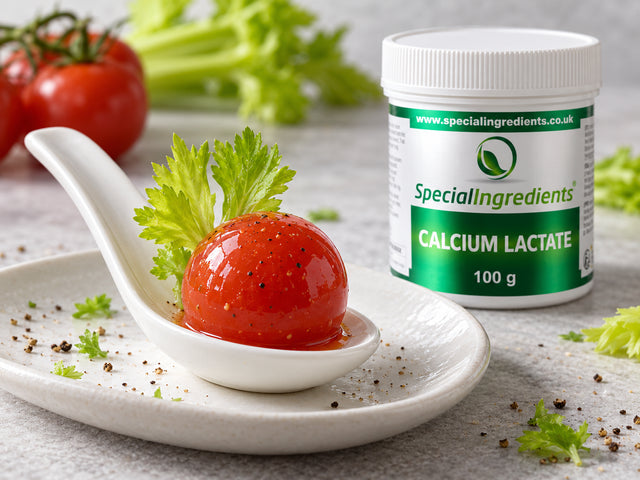
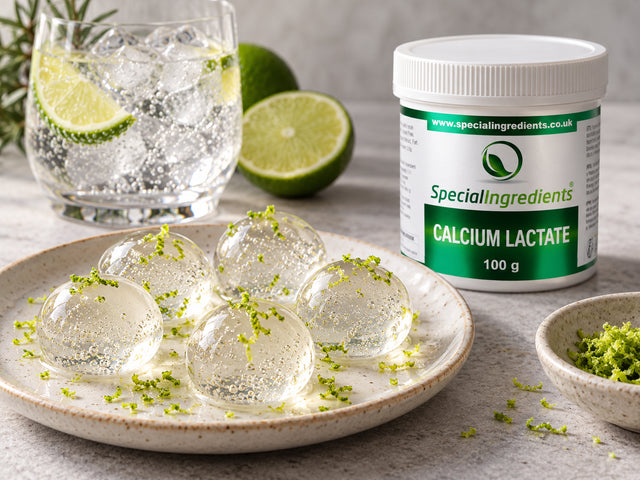
Spherification and reverse spherification use calcium lactate and sodium alginate to create gel-like spheres. In spherification, a sodium alginate solution is dropped into a calcium lactate bath, forming a gel membrane around the liquid. Reverse spherification drops a calcium lactate mixture into a sodium alginate bath, producing more stable spheres. These techniques are popular in modern gastronomy for visually striking dishes with unique textures. For ideas, visit our recipe page.